You walk out of your annual physical with a clean bill of health. Your fasting glucose looks fine. Your A1C is in the normal range. Your doctor smiles and says, “Everything looks great — see you next year.” But something still feels off. The fatigue, the belly weight, the cravings — none of it is in your imagination. So why does the bloodwork keep saying you are healthy?
The answer is often the same: your doctor did not run the right test. The HOMA-IR test is one of the most useful early screens for insulin resistance, and it almost never appears on a standard lab panel. Dr. Allison Barbee, the Obesity Medicine physician at Sustain MD, runs HOMA-IR routinely on patients who have been told they are “fine” but feel anything but. Here is what the test is, why it matters, and how to ask for it.
What Is HOMA-IR?
HOMA-IR stands for Homeostatic Model Assessment of Insulin Resistance. It is not a single blood draw on its own — it is a simple calculation that uses two values you already get from a basic blood test: your fasting glucose and your fasting insulin. By multiplying them together and dividing by a constant, doctors get a number that estimates how hard your body is working to keep your blood sugar stable.
The lower the number, the more sensitive your cells are to insulin. The higher the number, the more your pancreas is working overtime to push sugar into cells that have stopped listening. HOMA-IR essentially gives you a snapshot of how well your insulin is doing its job — long before glucose ever starts to rise.
Why Standard Blood Work Misses Insulin Resistance
Standard physicals usually include a fasting glucose and sometimes an A1C. Both of these measure sugar in your blood. The problem is that for years — sometimes a decade — your pancreas can pump out enough extra insulin to keep your blood sugar looking perfectly normal. From the outside, your labs appear healthy. On the inside, your body is quietly compensating for a problem that is getting worse every year.
By the time fasting glucose finally rises into the prediabetes range, the underlying insulin resistance has often been building for a long time. Testing fasting insulin alongside glucose — and calculating HOMA-IR — catches the problem in its early, most reversible stage.
How HOMA-IR Is Calculated
The formula itself is simple. You take your fasting insulin level and multiply it by your fasting glucose, then divide by 405 (when glucose is measured in mg/dL, which is the standard in the United States). You do not need to do the math yourself — your physician will calculate it for you, or many lab portals will do it automatically.
What matters more is what the number means. While research labs use slightly different cutoffs, most clinicians look at the result through a few general ranges: lower numbers suggest healthy insulin sensitivity, mid-range numbers suggest early insulin resistance, and higher numbers suggest more advanced insulin resistance. The exact ranges your physician uses may vary, which is why interpretation should always happen with a doctor who understands your full picture.
Who Should Get a HOMA-IR Test?
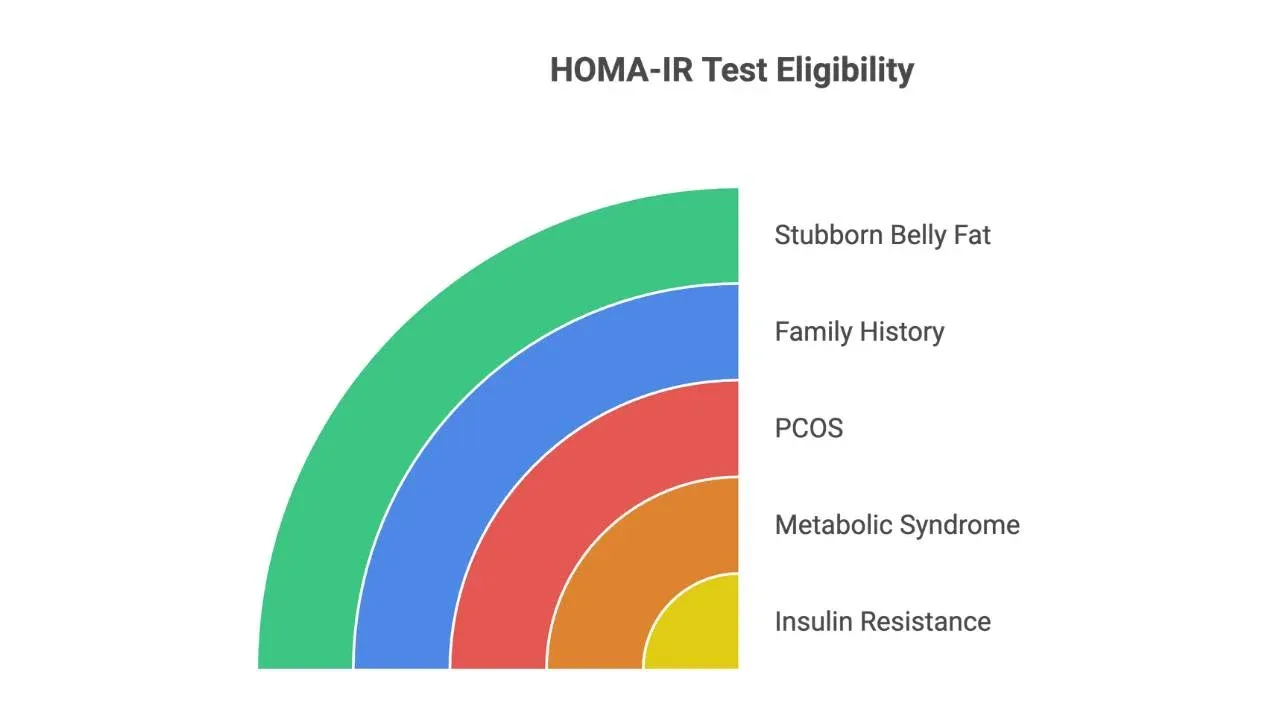
HOMA-IR is especially useful if you fall into any of these groups:
-
You have stubborn belly fat that will not respond to diet and exercise
-
You have a family history of type 2 diabetes
-
You have been diagnosed with PCOS or have irregular cycles
-
You have been told your fasting glucose is “borderline” or “on the higher end of normal”
-
You have signs of metabolic syndrome (high blood pressure, high triglycerides, low HDL)
-
You experience post-meal fatigue, brain fog, or strong sugar cravings
-
You are entering perimenopause and noticing rapid metabolic changes
If even one or two of these apply to you, asking for fasting insulin and a HOMA-IR calculation can give you years of early warning.
Why Most Doctors Skip This Test
It is not that physicians are ignoring you. Standard primary care guidelines tell doctors to screen for diabetes, not for insulin resistance. Insurance often covers glucose and A1C without question, while fasting insulin sometimes requires specific clinical reasoning. The result is that early insulin resistance falls into a gap — present, measurable, and treatable, but not on the standard checklist.
This is exactly the gap that Obesity Medicine and metabolic specialists fill. Dr. Allison Barbee orders fasting insulin and calculates HOMA-IR as part of her standard workup at Sustain MD because it changes the entire treatment conversation. Knowing your number lets you and your physician build a plan based on what is actually happening in your body, not what your labs are not showing.
How to Ask for a HOMA-IR Test
If you are seeing a primary care provider, you can simply ask: “Can we add a fasting insulin to my next blood draw so we can calculate my HOMA-IR?” Most physicians will be open to it, especially if you mention specific symptoms or family history. If your current provider is not familiar with the test or declines to run it, working with a metabolic-focused physician through telehealth is another option — and one that is often faster than waiting months for a specialist referral.
What Happens After the Test
A HOMA-IR result is most valuable when paired with the rest of your story — your symptoms, your goals, and your other lab values. A higher result is not a diagnosis or a life sentence. It is information, and information is what makes early intervention possible. With a clear picture of where your insulin sensitivity stands, your physician can recommend targeted nutrition changes, movement strategies, sleep work, and (when appropriate) medical support that can move the number in the right direction over the following months.
Most importantly, you stop guessing. You stop wondering whether the fatigue and the weight and the cravings are “all in your head.” You finally have a number that explains what your body has been telling you all along.
Frequently Asked Questions
Do I need to fast before a HOMA-IR test?
Yes. Both the glucose and insulin values used in the calculation must come from a fasting blood draw, typically 8 to 12 hours without food.
Is HOMA-IR covered by insurance?
Coverage varies. The fasting glucose is almost always covered; the fasting insulin sometimes requires a documented clinical reason.
Can HOMA-IR replace an A1C test?
No. They measure different things. HOMA-IR catches insulin issues earlier; A1C is still useful for tracking longer-term blood sugar control.
How often should I retest?
Most physicians recommend rechecking every 3 to 6 months while you are actively working to improve insulin sensitivity.
Can my number improve?
In many cases, yes. Lifestyle changes and medical treatment can meaningfully improve insulin sensitivity over time.
Can I get a HOMA-IR test through a virtual doctor?
In many cases, yes. Lifestyle changes and medical treatment can meaningfully improve insulin sensitivity over time.
Medical Disclaimer:
This article is for educational purposes only and is not a substitute for personalized medical advice, diagnosis, or treatment. Lab interpretation depends on individual context and should always involve a qualified healthcare provider. Reference ranges for HOMA-IR can vary between labs and clinical guidelines.